

Preliminary studies
Geological reconnaissance and pre-campaign studies, geotechnical and hydrogeological investigation.
What we do
Our services cover the full chain of exploration and production drilling: reconnaissance, sampling, grade control, geotechnical investigation and water.
01 — RAB / AC
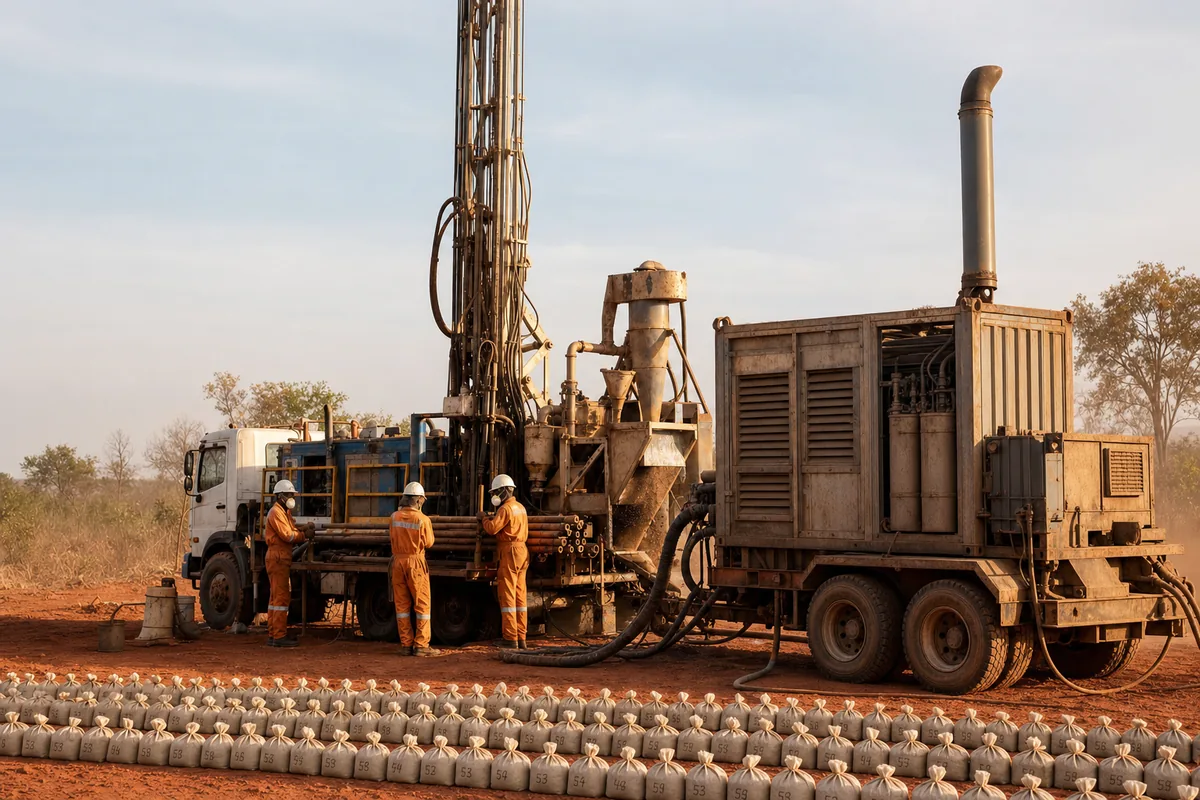
RAB and AC drilling use steel or tungsten blades to cut a hole through soft ground. Cuttings are lifted to surface by compressed air injected into the hole.
It is the fastest and most economical way to cover large areas early in a programme, frame a geochemical anomaly and direct later phases before committing to RC or diamond drilling.
02 — Reverse circulation
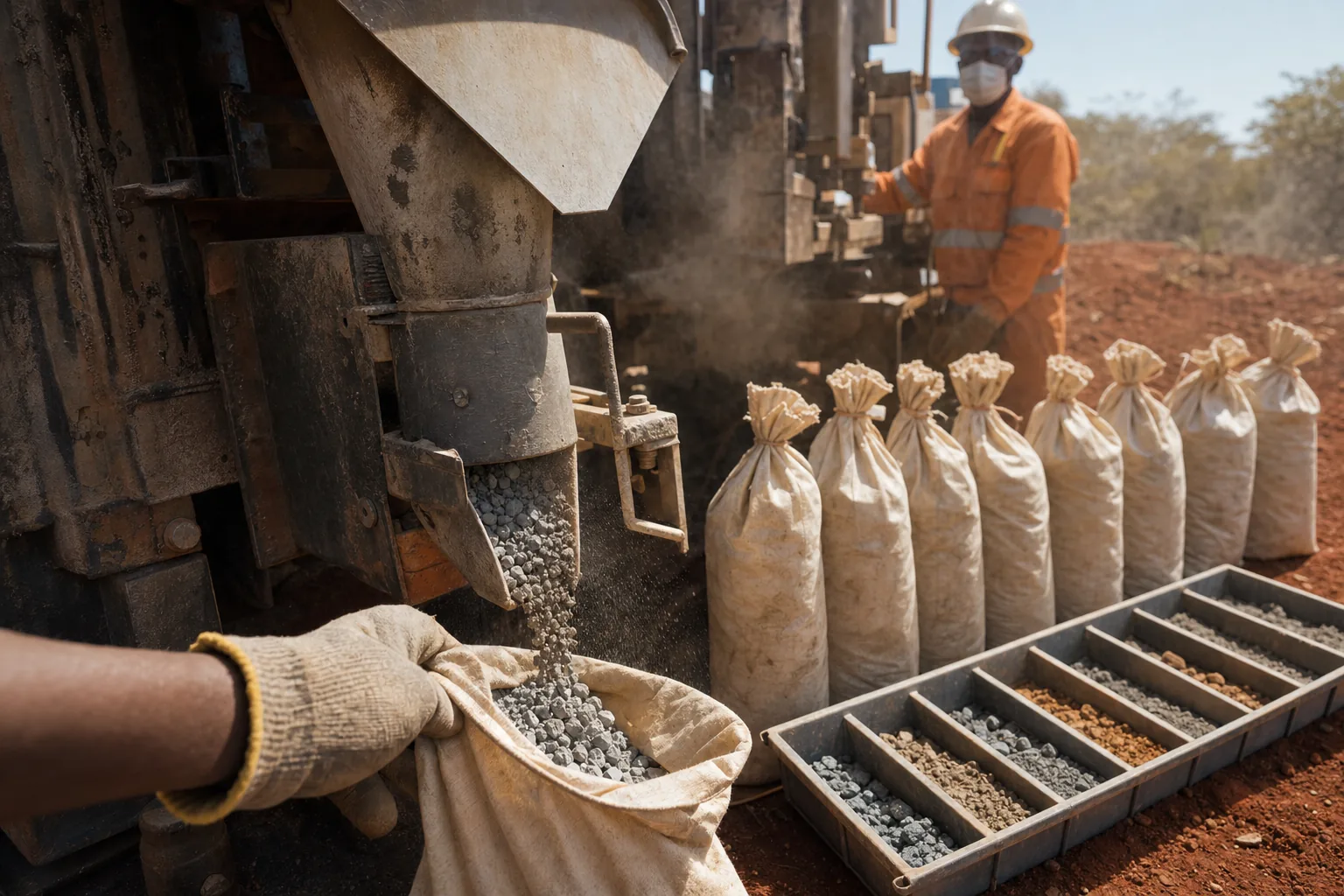
RC drilling is a destructive method giving accurate metre-by-metre sample recovery. Because the sample returns inside the drill rod, contamination from the walls of the hole is avoided.
It is the reference technique for grade control in open pit mining: it defines ore grade, traces the boundary between waste and orebody and feeds mine planning and blasting. It is also the most cost-effective way to turn targets into mineable volumes.
03 — Diamond core
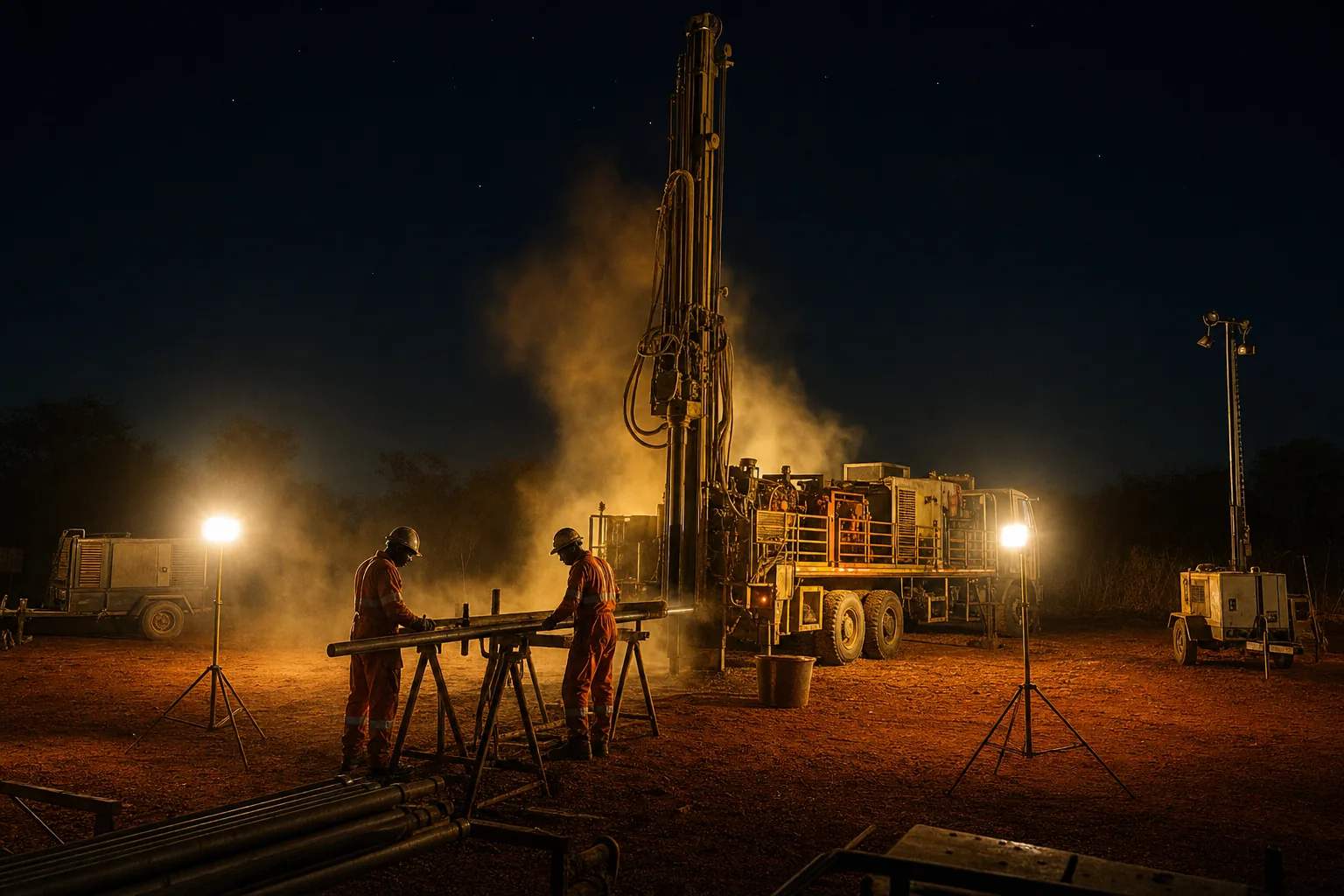
Diamond drilling is used to depths of up to 1,200 metres, with a diamond-impregnated annular bit cutting a cylindrical core of solid rock.
It is the only method that returns structure, dip, contacts and mineralisation in continuity. It is essential to resource estimation, metallurgical testwork and geotechnical characterisation.
Associated services
Geological reconnaissance and pre-campaign studies, geotechnical and hydrogeological investigation.
2D and 3D mapping, drone-assisted drilling supervision and GPS survey of collars and pads.
Transport and handover of samples to partner laboratories, following the client’s quality assurance protocol.
Management of pads, drilling mud and cuttings, and rehabilitation of the footprint after the campaign.
Choosing a method
| Objective | Method | Indicative depth | Sample type |
|---|---|---|---|
| Frame a surface anomaly | RAB / AC | 50 – 60 m | Cuttings, by interval |
| Exploration and delineation | RC | up to 350 m | Split cuttings, metre by metre |
| Grade control in production | RC | 0 – 250 m | Split cuttings, metre by metre |
| Resource estimation, structural | DD | up to 1,200 m | Intact rock core |
| Foundations and earthworks | RAB / AC, DD | per study | Cuttings or core |
| Water supply, dewatering | Down-the-hole hammer | per aquifer | Cased well |
Depths are indicative of each method. Contractual depths depend on the programme and on the rig mobilised.
Technical references
Our crews work to the published tool series and standards of mineral exploration drilling. Every figure below comes from a public reference, linked under each table.
| Designation | Core diameter | Hole diameter | Typical use |
|---|---|---|---|
| BQ | 36.4 mm | 59.6 mm | Deep reconnaissance holes, low sample mass |
| NQ | 47.6 mm | 75.3 mm | Exploration standard, depth against volume |
| NQ2 | 50.7 mm | 75.3 mm | Larger core for the same hole size |
| HQ | 63.5 mm | 95.6 mm | Resource estimation and metallurgical testwork |
| HQ3 | 61.1 mm | 95.6 mm | Triple tube, broken or weathered ground |
| PQ | 85.0 mm | 122.0 mm | High volume, geotechnical and large-scale testwork |
| PQ3 | 83.1 mm | 122.0 mm | Large triple tube, maximum recovery |
DCDMA designations carried into ISO 3551 and BS 4019, diameters published in the Boart Longyear diamond products catalogue. Triple tube preserves core structure in fractured ground.
| Parameter | Published reference value | Consequence on site |
|---|---|---|
| Bit range | 86 to 146 mm, 3″ to 5.5″ hammers | Diameter is chosen from target sample mass and hole stability |
| Typical 5.5″ hammer | 109.5 mm body, 121 to 136 mm bit, 102 mm rod | Sets the rod string and the lifting capacity required |
| Air demand | 830 cfm at 400 psi, 960 cfm at 500 psi | Sizes the compressor and makes a second-stage booster necessary |
| Working pressure | 350 to 500 psi in exploration | Requires hoses and maintenance rated for high pressure |
| Typical exploration rig | 127 to 165 mm, 35 bar, up to 250 m | Capacity benchmark for a truck-mounted RC rig |
Tool ranges and hammer specification published by Black Diamond Drilling and its BD542 data sheet; rig capacity published in the Epiroc Explorac 100 brochure; pressure range and booster arrangement in WorkSafe Western Australia mines safety bulletin no. 172.
| RQD | Rock mass quality | What it means for the programme |
|---|---|---|
| 0 – 25 % | Very poor | Triple tube and casing usually unavoidable |
| 25 – 50 % | Poor | Recovery must be protected, rate drops |
| 50 – 75 % | Fair | Double tube generally sufficient |
| 75 – 90 % | Good | Nominal advance rate |
| 90 – 100 % | Excellent | Sound rock mass, optimal advance |
RQD is the summed length of intact core pieces of at least 100 mm over the length of the run, measured along the core axis, per ASTM D6032. The classification grid is the one carried in Hoek’s rock mass classification, which recommends core of at least 54.7 mm taken with double tube.
Sample chain
A drilled metre is only worth the traceability of the sample it produces. Reporting codes and the technical literature set precise rules, which we apply on site together with the client geologist.
One standard, one blank and one duplicate every twenty samples, and the 5 to 20 % range: Abzalov, Exploration and Mining Geology, 2008. Unbiased splitting, third-party laboratory and regular deviation surveys: CIM mineral exploration best practice guidelines, 2018. Sample mass and cyclone splitting in RC: a published JORC Table 1. Instrument accuracy: DeviGyro and IMDEX OMNIx38.
Stated limits
| Method | Return principle | Recognised limit |
|---|---|---|
| RAB | Cuttings return outside the rod string | Exposed to contamination from the hole walls; not accepted as a resource estimation method |
| Air core | Cuttings return inside the inner tube | Markedly cleaner than RAB, but limited to soft ground |
| Reverse circulation | Return inside the rod, face-sampling hammer | Destructive method: no structural reading of the rock |
| Diamond core | Continuous core recovered in a tube | Slowest and most expensive per metre, but the only one delivering intact rock |
RAB and air core definitions from the drilling method vocabulary of Geoscience Australia. Wall contamination and the unsuitability of RAB for resource estimation: EXPLORE no. 130, Association of Applied Geochemists.
Water and geotechnical
| Service | Reference | Key point |
|---|---|---|
| Pumping test | ISO 14686:2003 | Test pumping methods for a water supply borehole |
| Borehole disinfection | WEDC / WHO technical note | Calcium hypochlorite 60 to 80 %, about 1 g per 20 L, 12 to 24 h contact |
| Annular sealing | California Water Well Standards | Annular seal at least two inches thick, standard cement, curing before work resumes |
| Standard penetration test | ASTM D1586/D1586M-18 | 63.5 kg hammer, 750 mm drop, 50 mm sampler, count between 0.15 and 0.45 m |
| Menard pressuremeter | ISO 22476-4:2021 | In-situ test of soil deformability and failure |
| Sampling | ISO 22475-1:2021 | Sampling methods and groundwater measurements |
Metreage, depths, diameters, location and schedule: those five items are enough for us to return a technical and commercial proposal.