
Reverse circulation
RC drilling in Côte d’Ivoire and West Africa
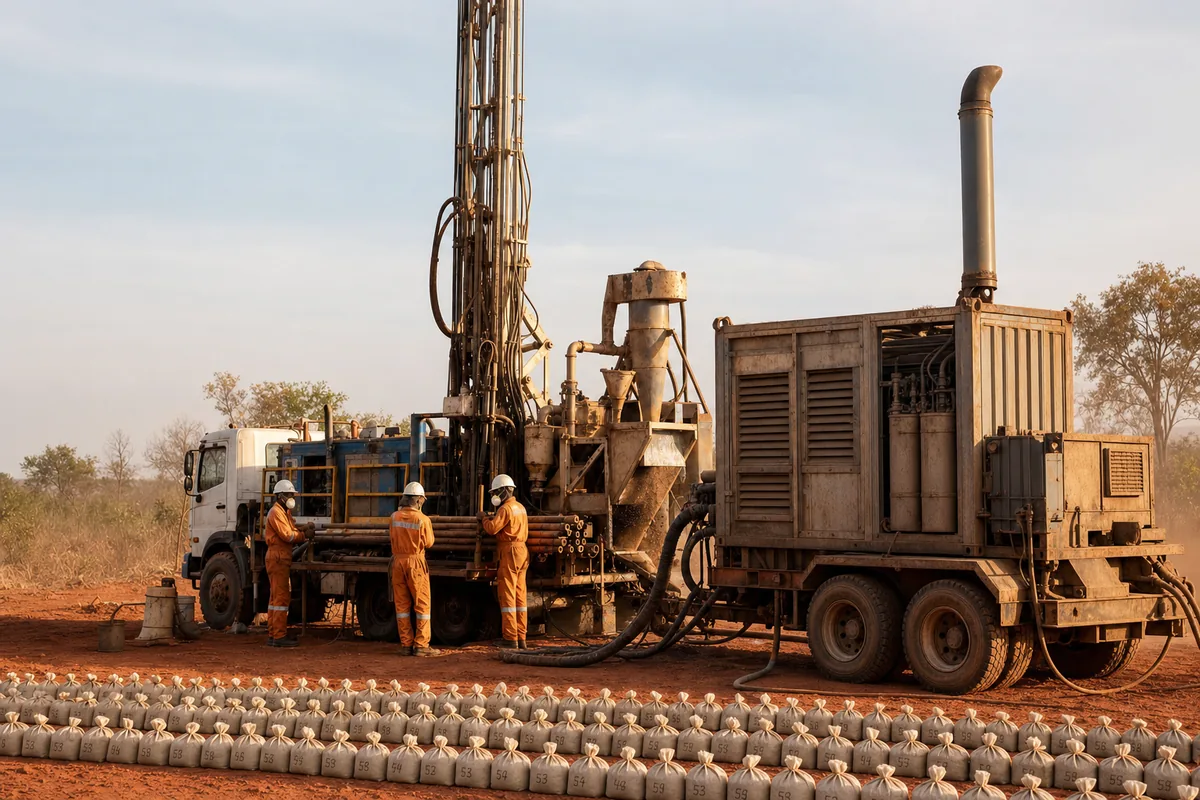
Reverse circulation is our volume business: a clean sample, metre by metre, to 350 metres, on a continuous 24-hour regime.
Why RC is the reference method for grade control
In reverse circulation, cuttings travel back up inside the drill string rather than along the hole walls. The sample is therefore not contaminated by the formations drilled through, and that property alone is what allows a boundary between waste and ore to be decided.
RC is both the grade control technique in open pit mining and the most cost-effective way to convert exploration targets into mineable volumes. It sits between RAB/AC reconnaissance and diamond core drilling without replacing either.
- Depth — up to 350 metres depending on rig and ground.
- Rate — 150 metres per day as planning basis, 200 metres per day as target.
- Deliverable — split, bagged and numbered sample, per-hole drill log and GPS survey of the collar.
Reference configuration
Our reference RC configuration
The configuration below is our reference basis for a continuous exploration and grade control programme. The rigs actually mobilised are specified in each proposal.
| Reference rigs | SCHRAMM T685, T685WS and TXD; Sandvik DR400i and DR410i; Atlas Copco Explorac 220C; EDM range |
|---|---|
| Hole diameter | 5¼ inch (133 mm) |
| Casing | 4½ inch (114 mm) outer, 3 inch (76 mm) inner, API RC thread |
| Working pressure | 350 to 500 psi |
| Regime | 24/7, 12-hour shifts, four crews per rig |
| Manning per rig | 18 people: site supervisor, drillers, offsiders, mechanics, electrician, welder and HSE officer |
| Mobilisation | Specified in each proposal |
Sample chain
What makes a grade defensible
Traceability
Metre-by-metre bagging, continuous sequential numbering, chip trays and a per-hole drill log.
QAQC
Blanks, duplicates and certified standards inserted following your protocol, not ours. Delivery to the laboratories you designate.
Rig availability
Senior mechanics, electrician and welder embedded in the shift, to repair on site rather than wait for a workshop hundreds of kilometres away.
Commitments in our proposals
Monthly measured availability target, sample quality target and mobilisation deadline, specified in each proposal.
FAQ
Frequently asked questions about RC drilling
What is reverse circulation (RC) drilling?
RC drilling is a destructive method in which cuttings travel back up inside the drill string rather than along the hole walls. The sample is therefore recovered metre by metre without contamination from the formations drilled through, which makes it the reference method for grade control and orebody delineation in open pit mining.
How deep does Elohim Drilling drill in RC?
Up to 350 metres, depending on the rig mobilised and ground conditions. The reference configuration uses a 5¼ inch (133 mm) hole with 4½ inch (114 mm) outer and 3 inch (76 mm) inner casing on API RC thread, at 350 to 500 psi working pressure.
What production rate can be expected from one RC rig?
On a continuous programme in 12-hour shifts, Elohim Drilling's planning basis is 150 metres per day per rig, with 200 metres per day as the target. Actual rates depend on ground hardness, hole depth and the distance between pads.
Which countries does Elohim Drilling operate in?
Elohim Drilling is incorporated in Côte d'Ivoire, where its operating base is located, and works in Côte d'Ivoire, Mali, Guinea and Burkina Faso. Its drillers and mechanics have also worked, over the course of their careers, on sites in Guinea, Mali, Ghana, Gabon, the Democratic Republic of Congo and Mauritania.
What is delivered for each metre drilled?
A split, bagged sample numbered in continuous sequential rotation, with a per-hole drill log and GPS survey of the collar. QAQC samples — blanks, duplicates, certified standards — are inserted following the client's protocol, not an imposed one.
Which RC rigs can be mobilised?
Our crews are operational on SCHRAMM T685, T685WS and TXD, Sandvik DR400i and DR410i, Atlas Copco Explorac 220C and the EDM range. The rigs actually mobilised are specified in each proposal.
Tell us what you need to drill in RC.
Metreage, target depths, location and schedule: we come back within 48 working hours with a technical and commercial proposal.